
Replace better with a specific question
A new bookstand may look stronger, lighter, or easier to adjust than the first version. Those impressions are useful starting points, but they do not yet specify a test. Choose one question that would help decide the next design change. For example, does a different support shape keep the same book in the intended position more reliably during ordinary page turning?
This is a deliberately modest invention example. It involves no medical claims and no prediction about commercial success. Its purpose is to show how a small comparison becomes interpretable. The test should be narrow enough that a surprising observation leads to a useful question, instead of leaving you uncertain about which of several changes caused the difference.
State the requirement before building again
NASA's engineering-design guidance describes a process of identifying a problem, building and testing a solution, and improving the design. [1] For the bookstand, translate the problem into a requirement you can observe. A statement about supporting a particular reading task is more useful than a statement that the new version should be excellent or professional.
Write down the conditions that belong to the requirement. Is the stand intended for a desk, a kitchen counter, or a crowded shelf? Is its purpose to hold a paperback open or to support a closed reference book? These decisions define the comparison. If the intended use changes midway through testing, record that change as a new question rather than rewriting the original aim afterward.
Choose what changes and what stays the same
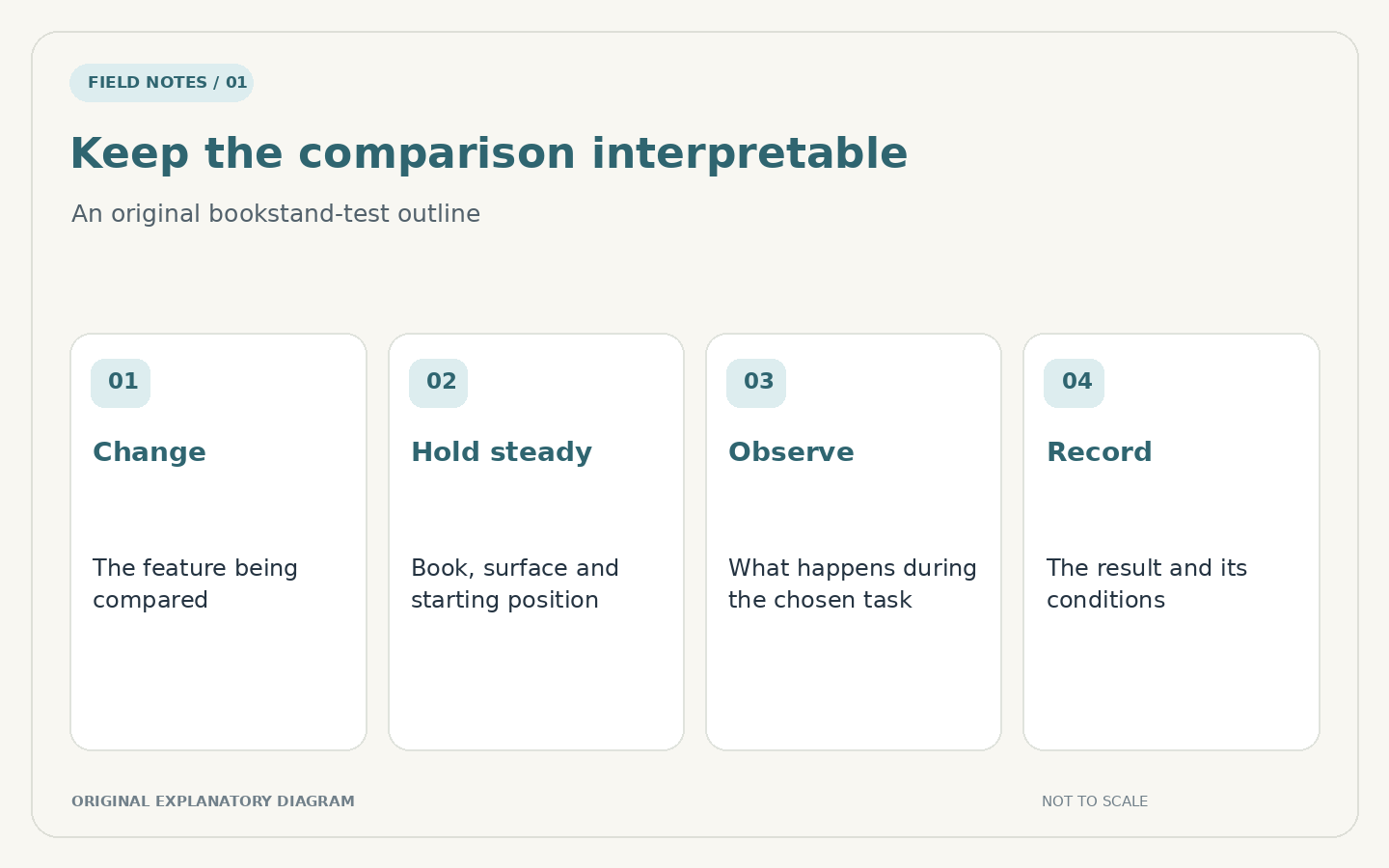
Suppose the support shape is the feature under discussion. Keep the book, surface, starting position, and adjustment procedure consistent between versions. This does not make the exercise a complete product evaluation. It helps isolate the question you chose. If you also replace the hinge and add a different gripping material, an observed difference will have several plausible explanations.
Make a short setup card before beginning. It can name the version, the book, the surface, and the task. Use a drawing if the starting position is hard to describe. Someone else should be able to understand what was compared without standing beside you. That record also helps when you return to the project after forgetting an apparently obvious detail of the original setup.
Decide what counts as an observation
Choose an observation that answers the question directly. You might record whether the book shifts out of the intended position, which part moved first, and what action preceded the movement. Avoid turning every impression into a numerical score. A clear description of the point of failure can be more useful than a rating whose meaning changes between attempts.
If a measurement is necessary, define how it is taken. A distance should have a named starting point, endpoint, and unit. A duration should have a clear start and stop event. These definitions prevent a comparison from depending on the observer's mood or memory. They also reveal when a measurement does not actually address the problem the prototype is meant to solve.
Notice the limits of the measuring process
NIST explains that measurement involves a defined quantity and that uncertainty describes the dispersion of values reasonably attributable to it. [2] In an informal prototype exercise, the practical lesson is to ask what the measuring process can distinguish. A ruler, a loosely defined edge, and a variable starting position may not support the fine distinction a design claim implies.
Keep the observation at a level the setup can support. Do not add decimal places merely because a spreadsheet allows them. If two versions appear indistinguishable under the chosen procedure, record that outcome. It may mean the design difference is unimportant for this task, or that a better-defined comparison is needed. The record should preserve the uncertainty instead of disguising it as precision.
Repeat without changing the question
Try the same ordinary task more than once and record each attempt rather than retaining only the neatest demonstration. Repetition can expose a loose part, an inconsistent adjustment, or a setup detail you forgot to control. The aim is to learn how the observation behaves when the stated conditions are repeated, not to accumulate a decorative stack of results.
If you notice a problem with the procedure, stop and describe it before revising the setup. Keep results from the earlier procedure separate. Otherwise, the final record may combine attempts that answered different questions. A failed comparison can still be valuable when it shows what must be specified next. Quietly removing inconvenient attempts loses that information and makes the prototype seem more settled than it is.
Invite another person to read the setup
Ask someone unfamiliar with the design to explain what the setup card asks them to do. They may identify an ambiguous instruction, such as turn the page normally, that contains several possible actions. Decide whether the variation matters for the purpose of the comparison. If it does, specify the action more clearly; if it does not, record the allowed variation.
Do not coach the person toward the result you expect. Describe the task and let their questions reveal what the record leaves out. This is a small review of the test's clarity, not proof that the product suits every user. It can nevertheless expose a practical problem early, before a polished demonstration persuades the team to stop examining the design.
Separate the result from the next design idea
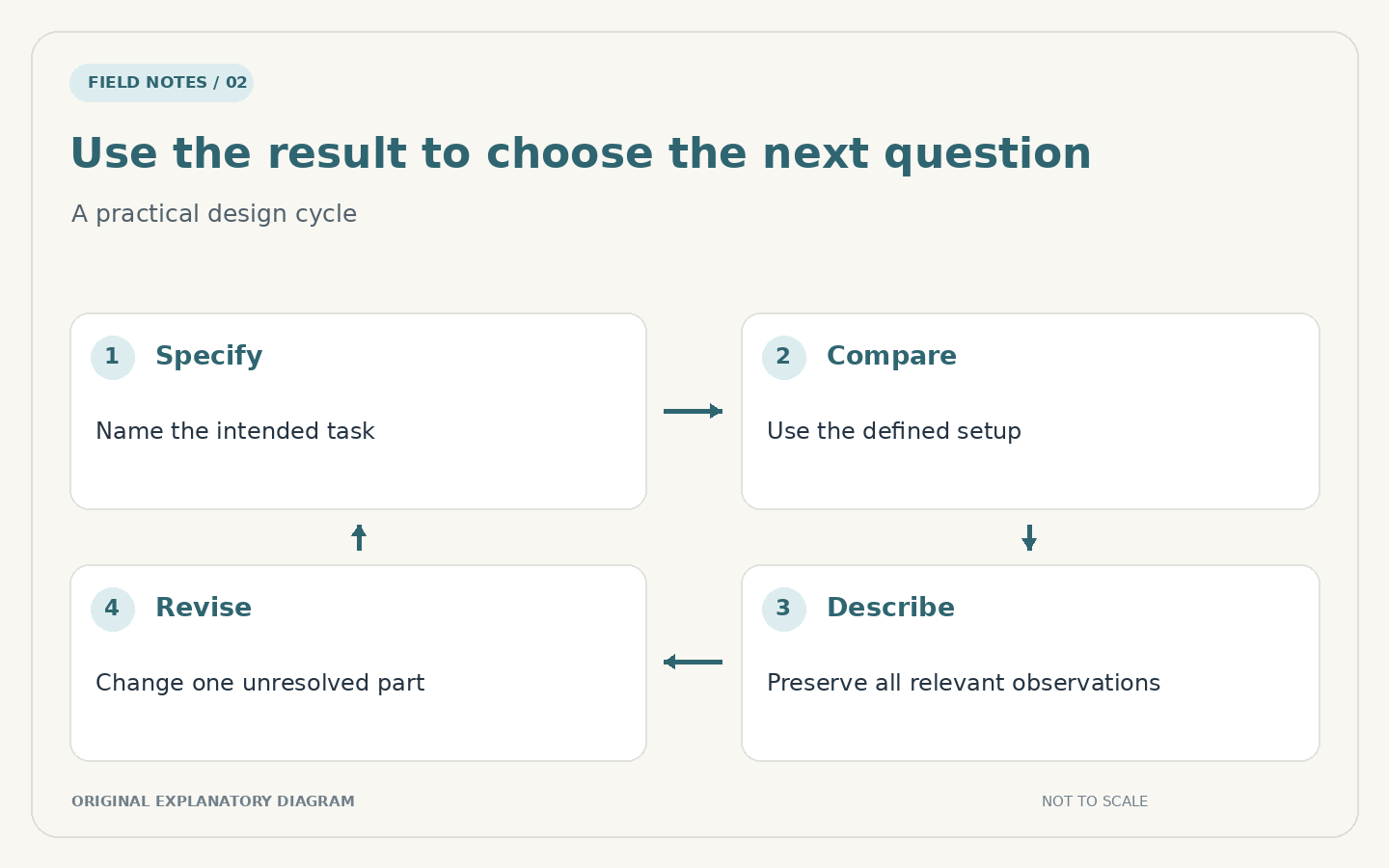
After the comparison, write two short notes: what was observed and what you propose to change. A page that moved during one action is an observation. A wider support might help is a design idea. Both belong in the project record, but they should remain distinguishable so the next version does not inherit an untested explanation as an established fact.
Choose the next change according to the remaining uncertainty. Perhaps the support shape is adequate and the adjustment mechanism needs attention. Perhaps the reading task itself was poorly defined. A useful prototype record allows either conclusion. It should not force every result into a story in which the newest version is automatically better simply because more work went into building it.
Keep the evidence attached to the version
Label the prototype and its record so that later photographs, notes, and observations refer to the correct version. Preserve an ordinary image of the setup when that helps another person understand it. The record need not be elaborate. It needs to keep the design question, testing conditions, and observed result connected.
The finished exercise should leave you with a defensible next decision. You may improve the design, refine the comparison, or decide that a proposed change does not matter for the intended task. Each is a useful outcome. One well-defined test can move an invention forward because it makes the next question smaller and clearer, rather than because it produces an impressive-looking number.
Sources
- Engineering Design Process Flow Chart — NASA Jet Propulsion Laboratory
- Measurement Uncertainty — National Institute of Standards and Technology
 We do our best to introduce you to technology better
